Wednesday, March 14, 2012

Welcome to Dragonfly: Faemore's Faerie Totem!

Photobucket

I've always been fascinated by dragonflies, and thought them the messengers of Faerie. Their wings of diaphanous, iridescent, prismatic light told me they were not native to the world, but from a realm in between and far away and quite around the bend. Their slender, segmented bodies spoke to me of grace and clarity and the wisdom of recognising an end, and a beginning. All-seeing, multifaceted eyes see all the worlds, without and within, and their inhabitants and their stories and their times. Dragonfly reminds me of Purpose more than any other of my totems. Let's get to know him better together.

Dragonfly symbolises the power of pure light. He inhabits three realms: air and water and Faerie, and the influences of these three elements are felt by Dragonfly people like myself. I was very emotional and passionate during my earlier years because of the influence of water, but now, I find myself more balanced with greater mental clarity as I mature because of the influence of air. Dragonfly is the essence of the winds of change, the messages of wisdom and enlightenment, and the communication from the elemental world. He beckons me to seek out the parts of myself that need changing. I call on him to guide me through the mists of illusion to the pathway of transformation.

The number two is important to Dragonfly. In our Correllian Nativist Wicca Tradition two is symbolic of assistance, partnership and peace. Dragonfly brings the light and colour of balance, transformation and serenity into my life.

Photobucket

Dragonfly babies are called nymphs. This is beautiful to me, for nymphs are the daughters of water. These nymphs live nearly two years at the bottom of ponds and streams. When they become adults they transform into dragonflies and ascend to the air. They travel on wings that sparkle and shimmer with spectacular colours, reflecting and refracting light. No insect can maneuver like Dragonfly on his wings. He can twist, turn, move up and then down, fly backwards and change directions instantaneously, and still spot movement from great distances away with his eyes of many facets.

The power of Dragonfly lies in his ability to see around things by looking at them from different angles. His ability to transform colours and light by reflecting and refracting them, shows me that life, like light, can bend and shift and transform in myriad ways, making life's appearance, never what it appears to be. Dragonfly magick helps me to see through life's illusions, and find my very own true vision. It calls me, just like Baba Yaga, to transform within my life, and reminds me to feel deeply so that I may have the compassion to help others and myself.

Photobucket

As a creature of the wind, Dragonfly represents change. His iridescent wings are incredibly sensitive to the slightest breeze, and tells me to heed where the wind blows. As a creature of the water, he symbolises the subconscious and dreaming, mind and thoughts. Meditate on his meaning for you. For the Asians and the Native Americans, Dragonfly represents prosperity, good luck, strength, peace, harmony and purity. For me he means "think deeper", for he carries messages of deeper thought, and ask that I pay attention to mine, and to my desires. As Dragonfly skitters across the surface of waters, he tells me that my deeper thoughts are surfacing, and that I must be mindful of the outcome I wish to have.

Dragonfly reminds me that when my deeper thoughts rise to the surface I must pay attention, for there are lessons to be learned. I am also reminded that what I think is a reflection of what I "see" on the surface; that my thoughts are responsible for what I see manifest in my life and my surroundings; physically, emotionally, psychologically, spiritually and magickally. Above all because of his short life span, Dragonfly reminds me to live life to the fullest with what I have!

Photobucket

Dragonfly is one of nature's shape shifters. As my magickal totemic guide, he signifies my ability to transform myself as I travel onward on my path of self-knowing, towards enlightenment, which his wings represent. His iridescent and shifting colours lift me into dreamtime, where I understand that "reality" is but an illusion. My inner visions are channeled through my unconscious mind, ever connected to The Great Mystery that is life - Goddess. Dragonfly remind me to celebrate Spirit in all living beings, to dig deeper, to lift the illusion of suffering and to believe in our own boundless Divinity.

It is said that Dragonfly was once Dragon, covered with beautiful, shimmering scales, and wielding great inner strength. He could change form at will and light the darkness with the fires of his breath. But he was tricked into changing form and believing himself a tiny dragonfly. Dragon got caught in his own illusion, just as we are forever accepting our facade as our true selves. We have forgotten that we too can change form at will, wield great inner powers, and can light our darkness with the fires of our faith and will, resolve and knowing. Dragonfly teaches me to take the time to develop properly and pierce my self-made illusions.

Photobucket

In flight, Dragonfly mates, hunts, feeds and lays eggs on the wing. Because of this he is associated with nature spirits, devas and faeries. His wings, like theirs, are clear but can appeared coloured in different light. Likewise, our emotions colour our reality. Dragonfly is one of the animal spirit guides to the Goddess Freya, and just like with her, he teaches me refinement and relentlessness and creativity. He never gives up, never rests for more than a few moments, and neither do I. He is relentless, as I am. It is how I've always developed my life - relentlessly, unwavering, in constant motion, but with clear vision.

One of the most magickal sights on a summer evening is that of the dragonfly. With his shimmering wings and graceful form, he seems a creature from the land of Faerie, and indeed he is. He is a powerful animal, who aids me in communing with nature spirits. His magick breaks illusions, especially those illusions that prevent growth and maturity. Dragonfly is the bringer of visions of power. Flighty and carefree, he symbolises whirlwind swiftness and action. He is of the dreamtime and the illusory facade we accept as physical reality. His iridescent wings remind me of colours not found in our everyday experience. Dragonfly's shifting of colour and energy, form and movement explodes into my mind, bringing back memories and musings reminiscent of a time and place where magick reigns - ... Faerie ...

Photobucket

The elemental world is composed of the tiny spirits of plants, air, fire, water and earth. It is a world full of nature spirits. It is my home, a Faerie place, and it is Dragonfly's home. Part of his magick is his ability to play amongst the air currents here, dazzling others with his light. He warns me not to fool myself as he had, and to break down the illusions that have restricted my actions and ideas. Dragonfly inspires me spend time outdoors with him, in the sunlight with him, soaking up the streaming rays of its warmth and light and love.

Dragonfly incites me to question the illusion which I can call reality, particularly the part of that reality which limits my ability to grow and create transformation in my life. He speaks of greater, deeper dimensions of reality and helps me to travel to a realm of light and colour in which spiritual evolution and expansion are possible. His rainbow, prismatic wings encourage me to live in a world of magick. I am a dreamer, absorbing light and energy, flitting from new creation to new creation, new story to new story, new beginning to new beginning. I never forget to ground and earth, for Earth is my very essence, as Capricorn and as Faerie, but I also never forget to fly, all because of Dragonfly ... totemic guide of my spirit.

Whimsically yours,
Rev. Faemore Lorei.

Photobucket

Tuesday, January 17, 2012

Tween Times

Photobucket

As Faerie, the tween times have always been mine. I have always belonged to the dusky twilight and the late autumn, the blustery, stormy days filled with a dark blue ocean of clouds and to the sunsets and dawns wonder-woven with bright golds and flamingo tangerines, richly-bruised by purple and periwinkle with the settling night and the oncoming day. I have always belonged to these times. They shape my senses and sentiments, connecting me to the spheres, the spiral and the Goddess. Their quiet, windswept, shimmering song fills me with love and life, spirit and power, serenity and joy. It has always inspired me to dance deeply upon the spiral, and it has always been my own.

Autumn is one of the four temperate seasons, and my favourite. It is the cusp of the shifting from summer into winter, and the time of year that the arrival of night and the setting of the sun become noticeably earlier. The autumnal season was once called "the harvest", before the word harvest lost its connection to the time of year, and came to connote the actually activity of reaping during this time only. The word autumn as well as fall began to replace its connection to this seasonal time. The alternative word fall is a contraction of Middle English expressions meaning "fall from a height", "fall of the leaf" and "fall of the year". It is the exhaled breath of the Crone, unlike the inhaled breath of the Maiden, or the full, held breath of the Mother, or the empty, suspended breath of the Dark Lady.

Photobucket

Autumn is associated with the change from warm weather to cold weather. It is the season of the harvest. Personifications of autumn are usually beautiful, voluptuous females, well-fed and well-endowed, amply adorned with the fruits, vegetables and grains that ripen at this time. Many cultures feature autumnal harvest festivals, and extant echoes of these celebrations include the mid-autumn Thanksgiving holiday and also the many North American Indian festivals tied to the harvesting of autumnnally ripe foods gathered in the wilds. While most foods are harvested during the autumn, foods especially associated with the season include pumpkins and apples, which are used to make seasonal foods and beverages such as apple cider and pumpkin pie, and are integral and prevalent parts of both Thanksgiving and Halloween, or Samhain, the third and final harvest festival in the Wiccan wheel of the year.

It is little wonder then that I adore pumpkin-pecan and apple pies, liberally laced with cinnamon of course, and spiced apple cider and nutty honey mead, and any candle, incense or oil that carries the scent of them. Any faerie would, and all faeries do. The pervasive mood of these autumnal festivals is also one of my favourite tween times. It is a gladness for the fruits of the earth coalescing with a melancholia connected to the imminent arrival of a harsh winter. It is a perspective presented in the English poet John Keats' poem To Autumn, describing the season as a time of bounteous fecundity and a time of mellow fruitfulness. It is bittersweet and heavily nostalgic, poignant and raw, piercing and beautiful.

Photobucket

Autumn in poetry has often been associated with melancholy. The possibilities of summer are gone and the chill of winter is in the air. Skies turn grey, and many people turn inward, physically and mentally, emotionally and spiritually. The song of Autumn is characterised by strong, painful feelings of sorrow, where the maturation of the world has reached its prime and it now must look ahead to the inevitability of old age and death. The autumnal season is a tween time, emphasising and echoing both lushness and abundance, but also a sense of melancholia and reflection.

Autumn is also associated with the Halloween holiday, which in turn was influenced by Samhain, a Celtic autumnal festival and a seasonal sabbat of the Wiccan wheel of the year. Samhain is my favourite Sabbat followed by Litha and Yule. The thing I love most about these tween times in the changing of the colours of the leaves, and the colourful autumnal foliage - from the lustrous golds and bright oranges to the burnished titian reds and dark earthen browns. They are redolent and resonant of the colours of my soul's tapestry. In indian mythology, autumn is considered to be the season for the Goddess of learning, Saraswati, who is also known by the name Sharada, Goddess of Autumn.

Photobucket

Twilight is one of my favourite words. It is so shimmering and surreal, so whimsical and ... Faerie. It is the time between dawn and sunrise or between sunset and dusk, during which sun's light scatters in the upper atmosphere, illuminating the lower atmosphere, and the surface of the earth is neither completely lit nor completely dark. The sun itself is not visible to the eye because it is below the horizon. The special energy of the ambient light at this tween time, like a mantle over the lands, is powerful and beautiful, magickal and motherly, whimsical and wondrous, eerie and still. These tween times are the season of Witch, She who exists in places not places, and times not times, and realms within realms, and beyond. Twilight is sacred in Hinduism. It is called cow dust time. Many rituals including Sandhyavandanam and Puja are done at twilight. Just like with autumn and in Indian mythology, Hindus believe that this time is ideal for study and education.

I love overcast days. It feels like the world has turned topsy-turvy upside down on its head, draped over with a veil of mist and fog, so that the sky is an ocean of clouds, and the sea is a sky of dark waters, and all is blustery and stormy and grey. Overcast is that wonder time when the clouds, dark and heavy with unfelled rain, obscure the bright heat of the sun with a pale, muted, haze of grey. It is neither hot nor cold, but cool. It is neither bright nor dark, but dull. It is neither sharp nor blinding, but indistinct. It is like the Dreaming. It is like Otherworld. It is like home.

Photobucket

Dawn in the time that marks the beginning of twilight before sunrise. It is herald by the presence of pale sunlight, though the sun itself is still below the horizon. Many Indo-European mythologies have a goddess of the dawn, separate from the male Solar deity, derivations of which include Greek Eos, Roman Aurora, Indian Ushas, the Hindu male dawn deity Aruna, the Native American Anpao, entity with two faces, and hailing from my very own pantheon, the Slavic Zorya or Zornitsa.

In Slavic mythology The Zorya are ancient Slavic sky and light goddesses, honoured particularly in Russia. They are three Slavic dawn goddesses. They are also guardian goddesses, known as the Auroras. They guard and watch over the doomsday hound, Simargl, who is chained to the star Polaris in the constellation Ursa Minor, the "little bear". If the chain ever breaks, and the hound should ever get loose, it will devour the constellation and the universe will end. The Zorya represent the Morning Star, the Evening Star and the Midnight Star.

Photobucket

Sunset is the daily disappearance of the sun beneath the horizon. The brightly-spun apricot and auburn hues are stunning, and the afterglow of the setting sun sinking into the blues where the sea and sky kiss is exquisite. Little can compare to its beauty, for it is the beauty of Goddess herself, and it is divine. Sometimes just after sunset a flash of green can be seen across the face of the still waters. This is a moment of power and of wonder and of magick. To make a wish on the green flash is to move the entire universe to do your bidding. You are blessed to lay eyes on it even once in a lifetime.

These tween times - the times between summer and winter, between day and night, between sun and rain, dawn and sunrise, sunset and dusk, ekstasis and melancholia, are mine. They are mine because they are Faerie and because I am Faerie and because they are home. I belong to their fallen leaf wishes and lovely spicy scents, to their melancholic moods and colourful tones that cause me to reflect on my nature, and on the nature of the Divine. I belong to their beauty and their bluster, to their energies and their enigmas. They are my own.

Brightly-spun, wonder-woven,
Lady Faemore Lorei

Photobucket

The Seven Who Decreed Fate: Inanna, Queen of Heaven

Photobucket

The Sumerian pantheon and its mythologies are as complex as they are old. Inanna, the Queen of Heaven, is one of the Seven Who Decreed Fate, alongside An, Enki, Enlil, Utu, Ninhursag, and Nanna. In order to understand their pantheon and The Seven, one must first understand at least a little about their civilization.

Sumeria was "The Land of the civilized Lords" in the south of ancient Mesopotamia, in the region of modern day Iraq, between the Euphrates and the Tigris Rivers, and was the centre of all activity, technology and religion. It was made up of several city-states that formed themselves into a comprhensive group in the Uruk period, during the 4th millenium BC. Each was centered on a temple dedicated to the particular patron god or goddess of the city and ruled over by a priestly governor (ensi) or a King (lugal), who was intimately tied to the city's religious rites. The cities also took their names from their patron god/goddess.

There is evidence that there were people in that region who were very civilized and organized and practiced extensive year-round agriculture. The name of the Uruk period was taken from one of the City states that made up the Sumer. Because they had such a long and organized culture of farming, they were able to form huge cites, store large quantities of food and employ a huge labour force, which made the region very prosperous. The Sumerians also boast one of the earliest cuneiform scripts, which is the earliest known type of expressive writing. They created symbols that stood for letters and words, and strung them together in lines on clay tables. This is how we come to know more about them than other, sometimes even younger, civilizations: because they wrote everything down.
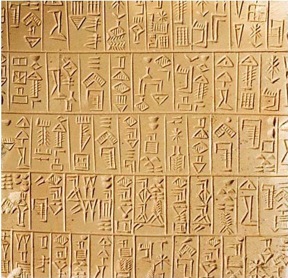

This is a Sumerian Tablet, showing the cuneiform for which the civilization is known. The Sumerian cuneiform is the oldest example of writing on earth.

They were one of the first peoples to use the wheel, to build magnificent walls, towers and temples. They employed elaborate irrigation techniques. They were some of the first astronomers, mapping the stars into sets of constellations, many of which survived in the zodiac and were also recognized by the ancient Greeks centuries later. They were pioneer mathematicians and inventors. They created fine painted pottery and jewellery of gold, copper, silver, lapis lazuli and carnelian. Sumerian women wore makeup, gold necklaces, and decorated their hair with various types of headdresses. Music was an important, intrinsic part of religious and civic life, and Sumer had many accomplished musicians and advanced musical instruments. Sumerian society was a patriarchal one, which is very important to understand. For a male-dominated society to hold a Goddess in such high esteem is no small thing. For even though they were male-dominated, they reckoned time by the moon. Sumerian mythology has since been assimlated into many cultures, including Egyptian, Judaic and even Celtic myth.

The Seven who Decreed Fate are accepted to be the Core Gods and Goddesses of Sumerian religion. It was around these Seven that the first city-states were formed. They were later seen as belonging to the same council of deities, and even when Sumer became swallowed up by Akkadia, these Seven remained largely unchanged but for slight modifications in their names.

The first of the Seven we will look at is Inanna. She is my Matron Deity.

Photobucket

For a little while now, Inanna has been calling to me. Yemaja will always be my Mama, and without jealousy she allows Inanna to be at the forefront of my mind and to tug at my heart. And it is without fear that I follow her: she unfolds my soul, sprouts my wings, challenges my heart and burns in my veins. Years ago, when I chose the name "Lilitu" as part of my Magickal name, I knew that it was an early form of Lillith, Goddess of Night, the first wife of Adam, the demon of Galilee, the sexually independent woman who both instills fear and commands respect. I found out much alter that Lillith is the announcer of Inanna, the embodiment of Inanna's sexuality. She is the Goddess of the Dark Moon, therefore also embodying Inanna's transformation. I am now doubly proud to have chosen this name.

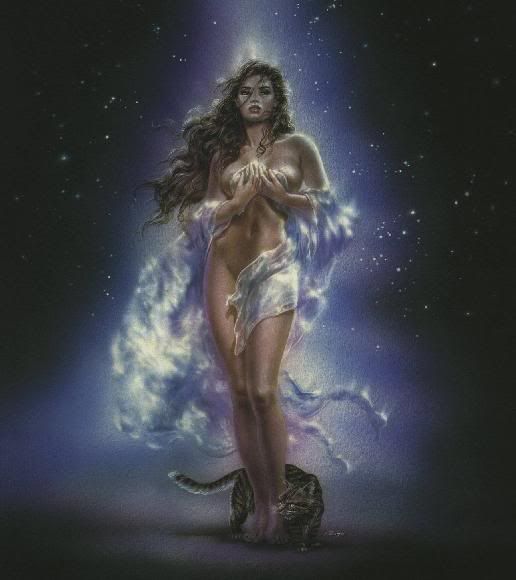
In a very masculine society, Inanna was the extremely powerful, revered Goddess of Sexual Love, Fertility, Infinite Plenty, Sexuality and War. She is the eight or sixteen-point evening star. She is the Transformatrix, the Dark Mother. She was duality incarnate, being so very feminine, the Queen of Heaven, and yet possessing such strong Male energy, commanding the battlefield. She is the Goddess of grain, composer of songs, healer and Lady of Myriad Offices. She is fiery, erotic, passionate, both chaotic and ordered, eternally youthful but wise. She is the embodiment of the Divine Feminine., eventualy known as Ishtar, Isis, Metis, Astarte, Neith, Breid and Cybele among others. Of all the ancient deities, Inanna has be the most reborn, reincarnated, assimilated goddess.
Photobucket

She is terrible and beautiful, fearsome and awesome. She is never frightening, only compelling. She is not gentle spirited, but she is not unkind to her priestesses and devotees. She has no time for pleasantries and games, she is straightforward and blunt. She is both the raging flood and the gentle rain. She grasps both breasts, offering them to the man that would dare call her Lover. She is strong and independent and reserves the right to choose her partners. She is seductive and irresistible, she is wanton and wild, sometimes unpredictable.

Photobucket

She is the keeper of the mes, the giver of culture, of the knowledge and mastery of art, maths, architecture, and all other mental and manual creation and skill. She challenged Enki, the god of culture, who jealously kept guard over the mes - tablets that contained the blueprints to everything that could possibly make up a culture, including Kingship, craft, science, speech, lovemaking, song, art, priesthood, truth, writing, and more. The mes grant the existence of and power over all aspects of civiliazation. Inanna tricked Enki and stole hundreds of the mes, thus shifting the strength of the civiliaztion from Eridu, Enki's territory, to Uruk, her own. Inanna later escaped attacks by sea monsters sent by Enki, and retain possesion of the mes that made her people and their culture so powerful. By doing this, Innana took her place as a Goddess of wisdom and fearlessness.

Photobucket

Her Love is not the gentle, romantic kind, Hers is the Love that will lay you bare, strip you naked, force you to surrender. Inanna does not call softly. It is not a sweet love, rather it is passionate, fiery and all consuming; the Love that sends men into battle and that fells kingdoms. she will destory those who stand in her way with her Love.

Photobucket

Later to the Akkadians and the Babylonians she became Ishtar and then Astarte, and she was softened to embrace romantic, sweet, gentle love. But that love is of Ishtar and Astarte, not the Love of Inanna. Hers was real, pragmatic, strong, all-encompassing and vivid, and all the more rewarding for being so strongly real.

Inanna is the keeper of Sexual Love, sensuality, pleasure and fulfillment - all the things that were considered an integral part of a successful, prosperous union. Inanna lives in the moment of pleasure, and in the moment of conception. She rewards faithful lovers with all the passion found on a battle field poured into sexual frenzy. She inspires us to be confident in our sensual and sexual desires, to be unapologetic.

She is Lust which consumes partners, and the fertility that results from the consummation of that Lust. She is the Goddess of Infinite Plenty and Bounty. Her priestesses were teachers of the secrets of sex and conception. All Fertility was a gift from Inanna, whose sensuousness drove others to be fruitful. So many years ago the land of Mesopotamia was not a barren desert as it is today, rather it was lush and exotic, overflowing with plant and animal life. The sumerians were expert farmers, and so looked to Inanna for the success of their crops.

Inanna is the strong and indomitable Mistress of War. Battle is the Dance of Inanna. Her breastplate is a beacon for her warriors to follow, or else her naked winged body, free of all fetters, chains and disguises, is an inspiring sight. She gives the gift of weapons and strategy, she guides the hands of her soldiers. She speeds conflict in battle, heating the blood of her warriors and cause chaos and confusion against those who are disobedient and against her enemies.

She wields her sword with deadly precision, riding upon the backs of her winged Lionesses. The Evening Star is her Mark upon the sky.

Inanna is also associated with the Planet Venus. The Sumerians were master astrologers and understood that Venus is irregular in her movement, and can disappear behind the Sun for 3 to 90 days at a time, it is erratic and dualistic, like Inanna. But there is always more to it than just what you can see on the surface. The disappearance of Venus directly relates to the most important of Inanna's myths: That of her Descent into the Underworld.

Photobucket

One day in summer, Inanna decides for reason unclear to visit the Underworld, and she dresses herself richly in garments that represented her control over the mes - a turban, a wig, a lapis lazuli necklace, beads on her breast, the pala dress, mascara, pectoral a golden ring and a lapis lazuli measuring rod - and sets off for the Gates of the Underworld. Before she leaves, she instructs her servant Ninshubur to plead with the gods Enlil, Nanna and Enki to save her should anything go amiss.

Ereshkigal, Inanna's twin sister and Mistress of the Underworld, is also her greatest rival. bound by the Law, Ereshikigal cannot leave the Underworld to join the living gods. Inanna is representative of everything that Erishkigal is not and cannot have, and thus Ereshikgal hates her. Innana its held fast to the same Law that binds Ereishkigal herself - just as she cannot step outside of her realm, so no god may visit the Underworld. If any god crosses into another realm, that god may never return from it. Ereshikgal is enraged at Innana's audactiy and instructs the Keeper, Neti, to have her remove a piece of clothing at each Gate, and to have the Queen of Heaven enter the throne room "bowed low". Inanna hands over her measuring rod to the Neti, saying that her reason for visiting is to attend the funeral of Ereshikgal's husband, who is in one version claimed to be Gudgal-ana, the Bull of Heaven killed by Gilgamesh, and in others is said to be the Plague god, Nergal.

As Innana descends further into the Underworld, she sheds more and more articles of clothing at each of the Seven Gates, and is told when she asks why to "be quiet...the ways of the Underworld are perfect. They may not be questioned."

Finally Inanna crouches before Ereshikigal, naked. Ereshkigal moves toward her twin sister, and Inanna moves behind her to claim the throne. However as Innana takes the throne, the Annunaki, Judges of Heaven and Earth who must uphold the Law, pass harsh judgment on her, screaming and howling at her. She shrivels into a dried corpse, a rotting piece of flesh, and she is hung, still naked, on a hook in the wall.

Ninshubur, empowered and trusted by Inanna, waits three days and nights and then, wailing and beating Innana's drum, approaches the gods. Enlil and Nanna are furious at Inanna and refuse to help, but Enki, deeply troubled, understands the nature of Inanna's journey, he understands the pain she shares with her sister. He fashions two figures, neither male nor female, out of the dirt under the his fingernails. He calls them the Kurgurra and Galatar, gives them the food and water of life, and instructs them to enter the Underworld like flies, visit Ereshkigal and ask for and receive only the corpse. They are warned that when they find Ereshikigal she will be moaning in pain like a woman in childbirth and that they are to moan with her, echoing her cries, but to accept no other gifts but Inanna's corpse.

Ereshkigal, appeased by their symathetic cries, offers the Kurgurra and Galatur her unique blessings, the water gifts, the River in its fullness, and the Grain gift, the fields of harvest, but each time, as instructed, they decline. They ask only for the corpse, which is the one gift that Ereshkigal wants to give but cannot offer. Finally Ereshkigal grants them the corpse, and they revive Inanna by sprinkling her with the food and water of life given them by Enki. As Inanna prepares to leave the Underworld, the Anunnaki seize her, stating that she must send a replacement for herself to the Underworld, and they send the demons of the Underworld, the galla, to cling to Inanna's sides until she finds a replacement.

When Inanna steps forth from the Gates of the Underworld, her faithful servant Ninshubur, dressed in rags, throws herself at her Queen's feet. The galla try to take her, but Inanna refuses to allow it, for Ninshubur has been supremely loyal. She also refuses to send her sons in her place, as they also mourned her death.

But Inanna's heartbreak is that her husband, the shepherd king Dumizid, instead of mourning her death, has dressed himself lavishly and openly lounges upon her throne, eating and drinking, and not acknowledging her return. She is enraged, and as punishment, she orders the galla to take Dumizid as her replacement to the Underworld. Dumizid's sister, Geshtinanna tries to rescue him, changing him into a snake, and then a gazelle, and even enduring the torture of the galla. When she is unsuccessful, she weeps from her belly, the anguish of a woman that Inanna understands only too well. Geshtinanna cries that she will share his fate, for he is her brother. Inanna, moved by Geshtinanna's self-sacrifice and loyalty even to the man who betrayed her, decrees that Dumizid and Geshtinanna will share their time in the Underworld, each going in turn to the Underworld for half the year. Inanna places them in the hands of the Eternal, therefore making them immortal, and thus neither will die as they come and go from the Underworld. Ninshubur is elevated to a priestess of Uruk. She remains loyal to Inanna eternally.

This myth shows Inanna's bravery, strength, and boldness, in facing the darker side of herself in her twin sister. It shows that she is not afraid to flaunt that he is the keeper of the mes, she strong willed and proud. It also demonstrates Inanna's loyalty to those that are loyal to her, her extreme wrath when betrayed, but also her compassion for courage and selflessness in the face of tragedy. Her death for three days is marked by the period of the Dark Moon, the Crone Time.

But it is more than that. This is the transformation of Inanna, Warrior, Heroine, Queen, Wife, Mother, into a Supreme Being through her own death. It is her spiritual initiation. She faced all that was dark in herself, represented by Ereshkigal: the lonely, anguished, unloving, unloved, sexually depraved, enraged, hateful, greedy place with potential life lies motionless, forever in the pangs of birth but never finally being born, the inertia of non-action and of bitterness. Inanna faced these things, endured Judgement, died, and emerged reborn and triumphant, relying on her Higher self (Ninshubur) and Divine Intervention, placing her trust both in her own strength and Self and also in that which is outside of herself. She calls upon us to do the same, to journey into the dark sides of ourselves, to face the death of our old mortal selves and embrace the pain that comes with it, for out of those ashes shall we arise new, clean spiritual beings.
Photobucket

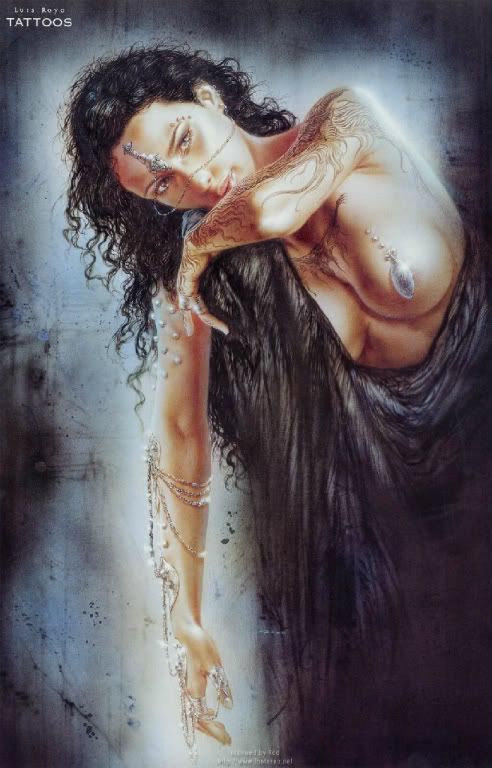
This is my Mama Inanna, in all her magnificent, terrible, glorious beauty. She commands my love and loyalty, she challenges me to journey into the darkness and step out again, radiant and renewed. She guards me, empowers me, sets fire to my heart. Hail Inanna, the Evening Star, the Radiant Venus, Queen of Heaven!

Brightest Blessings,
Selene Lilitu

Sunday, December 11, 2011

The Cat Familiar

Photobucket

For as far back as I can remember I have loved cats. I love their funny, faerie-chasing playfulness as kittens. I love their fierce inner lions, their wisdom and their affection. I love their whole-hearted acceptance of you as Theirs. I love their mighty pride and inherent sense of superiority and dominion over less special creatures like dogs (their thoughts not mine). I love how embarassed they are when they fail to perform any act without grace. I love the way they knead their love into the very fabric of your soul with their paws and purrs. I love how they give you tiny, little nips to show just how much they love you back.

Photobucket

In European folklore and the folk-beliefs of the Medieval era, familiars were supernatural beings believed to aid the wise ones in their practice of magickal arts. According to the anecdotes of the time, they would appear in numerous guises, often as an animal. The purpose of familiars is to serve the young witch, providing protection as she comes into her new powers. The witch's familiar is her companion. The witch and her familiar are drawn together as if by magnet, both intuitively knowing they are meant to be together. I know exactly what this is like, with my first familiar, Lola Le Fey, my faerie baby cat.

Photobucket
Lola le Fey, Faemore's first familiar. Love forever.

The witch and her familiar are similar in character as both are wise, independent and astute. When the witch and her cat familiar are at work together, the magickal pull is extremely powerful and they know instinctively that it is meant to be. A bonding takes place and the two form a lifelong alliance. The cat familiar has a mysterious air about it, and has for centuries been linked to all matters occult. Cat mythos first began in ancient Egypt, where they were worshipped as the embodiment of the gods. These stories of cats soon reached Greece, Asia and the rest of Europe, where cats then became associated with witches.

Photobucket

I learnt almost everything about magick from talking to my cat familiars, and working with them in my magick doubled every spell's power. They taught me how generate energy intensely, as they themselves do with their concentrated purring. They taught me how absolute True Will can be. They taught me how to align and attune myself to my most natural state of being. They taught me how to create my world magickally rather than mundanely. If you tell her your secrets you can be utterly certain your cat familiar will not betray your trust. You must of course gift the favour in return.

Photobucket

The familiar cat is a creature of habit, and like the witch she must be given her own sacred space, where she is to be left to her own devices and her needs are to be met. She will be of great assistance to her witch as she is a powerful magician herself and can attune to nature effortlessly, and manifest a variety of spells. The cat familiar is very intuitive and her sixth sense cannot be matched. She will definitely be a lifelong friend, and as cats are magickal creatures, you will always have mystery and magick within your home and your heart for all of your days.

Photobucket

As soon as the witch and her familiar have chosen each other, they will then choose a magickal name for the cat. The cat familiar with her particular magickal abilities is an invaluable participant in the making of magick, and meditation, divination and devotion. She enjoys working with the energy within a sacred circle. The witch is capable of telepathically communicating with her familiar and can trained her cat to be on the look out for earthly visitors, spectres and spirits, and living people who are good, or bad, as well.

Photobucket

The cat familiar always travels with the witch on the back of her broomstick, and they become more bonded as time goes by. The cat from a kitten has a certain air of worldly knowledge and from young participates in the witch's spirituality, worship and ritual. Familiars should always be thanked for their assistance and given treats for the support and love they offer the witch. The cat familiar loves catnip. She talks to her witch companion and lets her know what is going on in the outside world. She also lets her witch friend know if they are any changes occurring that she should look out for as well as chase away unwanted spirits.

Photobucket

The Egyptian goddess Bast is part cat, and sacrifices were once offered to ensure her blessings. The remains of cats that had been mummified thousands of years ago reveal the sacred role that the cat familiar played in ancient Egyptian culture. The cat familiar can be traced back to the Egyptians who treated her as a sacred creature. Followers of the Goddess Diana also considered the cat sacred because she once assumed the form of a cat, and cats were under her special protection. In Scandinavia, Freya's chariot was drawn by cats. The Celtic goddess Cerridwen was also attended by white cats, who carried out her orders on earth.

Photobucket
Bast, Goddess of Cats.

Once the familiar is chosen, aside from naming it, the witch places a magickal ring of protection around the animal. The cat familiar is very loyal and serves her owner well. Witches throughout time have had cat familiars and their familiars were traditionally black. The witch and her companion familiar become very attached to each other. If you have forgotten which ingredient to use in a spell because you didn't write it down, your cat familiar will knowingly move through your herb and plant area and place her paw on the ingredient you need.

Photobucket

A witch and her cat familiar are spiritually-bound and have a telepathic connection. A witch's familiar always knows when they are spirits around, and has no difficulty with communing with both worlds. The witch's familiar is able to guide her between the two. In the mid 1500's cats were recognised as the archetypal familiar for all witches. It was thought that a witch was able to turn herself into a cat. When the witch's familiar grows old and dies, she is able to guide the witch from the spirit world to find the new feline friend of her bosom, and she watches over the witch and her new companion familiar.

Photobucket
Dori, Selene's cat familiar.

Cats have been sacred to more than one religion, and at different times and places have been considered both good and bad bringers of luck, much like my totem animal Owl, also known as Cat with wings. The Egyptian Goddess Bast was both the lion-headed and the cat-headed and attended by cats. Therefore cats were sacred and revered in Egypt. Killing one was a heinous crime, and when a household cat died mourning rites were performed for it. Cats were often found in temples and were ritually fed as well. The household cat was also allowed the share the family's food.

Photobucket
Faemore's present cat familiar, Pino Beans. She is is little, little, peeny scenes.

Cat amulets were produced and elaborate cat-sized sarcophagi were crafted for cats who had died and were often embalmed as humans were. Whenever we see the image of a witch on her broomstick her loyal cat companion is always close by, and when a familiar is there as a witch is working, the spells she casts are always more powerful. It is important that the personality of the cat matches the personality of the witch. A witch's familiar can be her closest companion, offering moral support, special, arcane knowledge and physical and psychic healing. Know that when you are looking for your cat familiar she will very likely see you before you see her.

Brightly-spun blessings,
Lady Faemore Lorei.

Photobucket
It is the familiar spirit of the place;
It judges, presides, inspires Everything in its empire;
Is it perhaps a fairy or a god?
When my eyes, drawn like a magnet, to this cat that I love …
- Charles Baudelaire, a French poet, cat fancier, and believer in familiar spirits.

Tuesday, October 11, 2011

Slavic Mythology

Dedicated to my Gods, the guides and ancestors of my spirit. I have delayed devotion for too long.

Photobucket
Ivan and the Firebird

I have always been drawn to Russia. From the folkloric tales of Ivan and the Firebird and I Go I Know Not Whither to Fetch I Know Not What, which I ravenously devoured as a child, to the stories of Anastasia and Rasputin and Baba Yaga and Vasilisa the Brave, which have molded my inner realms as they grew and bloomed, I have always been enchanted by the dark whimsy that is Russian fantasy and faery tale, legend and mythos.

Photobucket
Vasilisa the Brave

Slavic pagan beliefs are ancient. The Old Faith of the ancient Slavs, their Gods, holy days and folklore, is most commonly called Native Faith or Rodnoverie by its Russian practitioners in its country of origin. Witchcraft, and its practices regarding healing and magick, has also survived through the ages to the present day. Although still decidedly Heathen, the Craft has adopted many Christian traditions and customs and prayers in order to ensure the survival of its practitioners as well.

One of the more common name for Witch in Slavic languages such as Russian is Ved'ma. Traditional Slavic Witches are either born as Witches or they inherit their powers from existing practitioners. Slavic witchcraft, its faith and its mythology, is a living tradition that is still very much a part of Slavic culture today. The Slavic peoples are not a race. Like the Romance and Germanic peoples, they are related by area and culture, not by blood.

Photobucket
The God-brothers Bialybog, "white god", Ruler of the Sky and Czarnebog, "black god", Ruler of the Underworld

The origins of Slavic beliefs like the rest of the world's, reside in animism and ancestral worship. The first spirits to emerge were called the Beregyni, female spirits that bring life, and are the predecessors of the Rusalki and the Upyr, spirits that bring death, and are the predecessors to our modern Vampire.

From this original dualism sprang belief in all of the nature spirits, and the Rod and Rozhenitsa, the God and the Goddess who imbue a newborn child with a soul and his or her fate. Although nearly all deities were ancestral, Rod and Rozhenitsa eventually pulled the slavic mind out of animistic, ancestral thinking.

Dualism permeates all of Slavic Pagan spirituality, and actually seems to be the basis for most of it. This is a theme of complimenting opposites such as darkness and light, female and male, winter and summer, death and life more similar to yin and yang, than it is to human constructs such as good and evil.

Photobucket
Poludnitsa, the Spirit of Noon, a frightening time

The God-brothers Bialybog, "white god" who ruled the sky and Czarnebog, "black god" who ruled the underworld, are illustrations of this polarity. Bialybog and Czarnebog are not actually the names of deity, but Taboo names used to describe the Gods of Earth and Sky in order to avoid accidentally invoking, harming or insulting them if their actual names were to be spoken out loud.

Other examples of dualism in the myths of the ancient Slavs are the two Rozhinitsy, the mother and daughter fates who visit the newborn to decide their destiny, the spirits of midnight, Polunocnitsa and noon, Poludnitsa, both times equally as frightening, and the Zorya - Goddesses of Dusk and Dawn.

Photobucket
Rusalki and Vodanoi, spirits who ruled most bodies of water
Photobucket

The ancient Slavs had a deep reverence for the four elements. Fire and Water were seen as sacred duality on the earthly plane. Often pots of water were offered to the stove and bonfires ritually set up near areas of water, one as a sacrifice to the other. Earth and Sky were seen as a more spiritual plane of duality. High places such as mountaintops or treetops, especially birch, linden and oak, became the sacred meeting places of the Sky Father and the Earth Mother. Where they met they would join their procreative forces, usually in a flash of lightning or a clap of thunder.

The winds were seen as the grandchildren of the God, Stribog. Rivers were treated with respect lest they should drown you when next you visit. There are records of sacrifices being made to rivers such as Dneiper and the Volga. Although many bodies of water had their own deities, most of them were ruled by spirits known as the Rusalki and Vodanoi, sometimes even the Water Tsar himself. Fire was personified by the god Ogon Svarozhich and it was considered a spiritual crime to spit into a flame. Mat' Syra Zemlja, Moist Mother Earth however, seems to be given, by far, the greatest amount of respect and reverence. As her devotee this thrills and delights me. The moist, mother Earth is sacred. My personal Patroness deity, whom I call Matka in affection, is worthy of worship and love.

Photobucket
Weles, the God of Cattle and Wealth

No one was allowed to strike Mat' Syra Zemlja with a hoe until the Spring Equinox, Maslenica, as she was considered pregnant until then. Earth was considered so sacred that oaths were sworn while holding a piece of her, sometimes in the mouth. Ancient wedding vows were taken while swallowing a clump of earth or holding it on the head. The custom of asking the Earth's forgiveness before death was still being observed far into the 20th century and it was considered appropriate to confess sins to the earth.

In a variation to the pairings of water and fire, earth and air, water was also seen as a gateway to the underworld, especially wells, and fire was seen as a child of the sky god, a Svarozhich, a "son of Svaroh". One could use water to enter the world of Nav, the underworld, or fire to contact the world of Prav, the laws of the Gods. Both of these paths were equally purifying, frightening and dangerous. By taking the live coals of three separate and separately gathered woods and adding them to the ritually gathered waters of three separate springs, one could go full circle and create a powerful and magickal agent called the "Water of Life", the most integral and magickal element in Slavic fairytales and traditional healing.

Photobucket
The Water Tsar, ruler of many bodies of water

Like the native Americans, it seems like each Slavic tribe had a totem animal that the clan was named after. It was considered taboo to kill or eat this animal except for in specific religious rituals. Each member of the tribe was thought to have an animal twin, and the death of that twin could cause the death of the tribe member. Wolves have always been a big part of Slavic folklore and custom. The name of the Pagan Priests, the Volkhvy, comes from the word for wolf, Vielk. All the people of Russia have the ability to turn into wolves. Wolf is my totem animal and spirit guide.

Photobucket
Svarozhich, a child of the Sky God, a Son of Svaroh

The Slavs believed that the world tree was divided into three parts; The roots existed in the realm of the underworld, "Nav", and were where the Zaltys, the world serpent, lived. The trunk existed in the mundane world and the uppermost branches reached into the land of the Sky Gods. A magickal bird, the fire bird, or phoenix, was said to live in the branches.

Some Slavs believed that the Earth was an Island floating in water that the sun was immersed in every evening. At the center of this island stood the world tree or mountain. The roots of this tree extended deep into the underworld and the branches reached high up into the realm of the Sky Gods, Irij. No one knows what kind of tree it is supposed to be. Some believe it to be the original tree from whence all other trees were created.

Nav was the underworld, the realm of the dead, from whence it got its name. Weles/Wolos, the god of cattle and wealth and Lada, Goddess of Springtime were also said to reside here. It is from the Underworld that Lada would return every spring.

Photobucket
The God, Svarog, Ruler of all Creation

According to the "Book of Veles", the progenitor, Rod, floated in the abyss trapped in a primordial egg. Lada or the personification of Love, was the first of the Gods created, and with her help, Rod was able to break out of his prison. Rod then began to create all of the universe and the Gods and Goddesses by pulling from himself, his eyes, his mouth, his brow ... until he finally seemed to dissipate and left the running of all his creation to the God, Svarog. In none of the native creation myths of the Slavic people, does God create the universe without help.

Brightly-spun breezes,
Faemore Lorei.

Photobucket
Lada, Goddess of Springtime and the Personification of Love

Tuesday, August 9, 2011

Forests: A Very Personal Piece from Faemore

Photobucket

Merry meet reader! I had this wonderful idea that I would write about forests, because I love them, and Selene could write about the moon, because she loves Her. So then I began to write, and this is as far as I got. Lol. Unlike with my previous articles this isn't a subject I can just research online and re-write in order to internalise the information. This is a subject I have to reach for within, an experience I have to expose and explore. The reason why I love forests could never be found on Wikipedia or Google or even in a book. Its in my heart, and with good reason. The very best things are.

Photobucket

Let us begin. Forests, also known as woods, wolds, wealds, holts, friths or firths, are vast, open expanses of landscape covered with a colossal congregation of trees. Trees are one of my favourite peoples in all of existence, so it is natural that any place where they grow in abudance is a place I absolutely love. Not only are forests home of trees, but they are also home to most of my favourite animals and things such as owls, bats, frogs, wildcats, wolves, moss and mushrooms. Lastly they are home to another one of my favourite peoples - the faeries.

Photobucket

Let us begin at the top. At the top of Forest is canopy, formed by the crowns of trees; habitat, shade and protection from winds and storms to the many unique, living beings, both flora and fauna that reside in Forest; some of whom live solely in canopy, never touching the ground. Canopy is the diadem, the most regal layer of the forest, imperial and magnificent. Owl is most often found in old Forest with high, multi-layered canopy, large trees beautified with holes and cavities for habitats and open space below for Her to fly.

Photobucket

Hanging down from the canopy of forests are vines, climbing plants, hanging in tendrils and trails, a favourite way for the tree faeries and frogs to travel when they aren't flying, flitting and hopping about. The vines entwine between the thick trunks of the trees. The trunks of the trees are covered in moss. Mushrooms sprout, making beds of the moss. The frogs and the faeries frolick, making toadstools of the mushrooms. There are knots and knurls, gnarls and holes in the trees. It is in these that the bats and the gnomes reside.

Photobucket

Wildcat sits up in the trees, cleaning her paws, squinting lazily in pale, dawn-dappled shade, only to shiver and hiss when Wolf throws back his head and howls at the moon waning. Moss - small, soft plants - grows close together, in clumps and mats, in dark, shady locations. Under canopy, they cover the forest floor. They do not have flowers or seeds, but their simple leaves cover thin, wiry stems. Magickal mushrooms, like hidden treasure, glow and shimmer in the shadow. Their fleshy, fungal, bioluminescent bodies composed of stem, polka-dot-speckled caps and connecting gills make perfect stools and beds for the faeries.

Photobucket

Tree hollows, cavities which have formed in the trunks and branches of trees, are found in the old ones here. The hollows of the trees are the features of the forest. They are the homes and habitats of myriad woodland creatures, organisms and wildlife species. Animals use hollows as both day time and night time dwellings, as well as sanctuaries for raising their young, feeding themselves and keeping warm in the cold. They hollow shop, searching for hollows with the perfect entrance ways, size and shape, depth and degree of warmth. Searching for home.

Photobucket

And this is what Forest is to me. Home. Somewhere here, in the haunting hoot of Owl, in the canopy-dappled moonlight and the verdant veil of vine, somewhere in the cheery whistling of tree frogs, in the knurly knots of gnome holes and the cool mossy hollows, somewhere in the purring and prowling of Wildcat, in the deep red, white-speckled caps of mushrooms and the piercing howl of Wolf, is my home. I know it can be dark. I know it can be daunting. I know it can be scary. I know it can be unknown. I also know it can be magickal and magnificent, beautiful enough to take the very breath from your soul, dreamy and full of wonder. I know; and this is why Forest will always be home in my heart. It is with good reason. The very best things are.

Brightly-spun breezes,
Faemore Lorei.

Photobucket